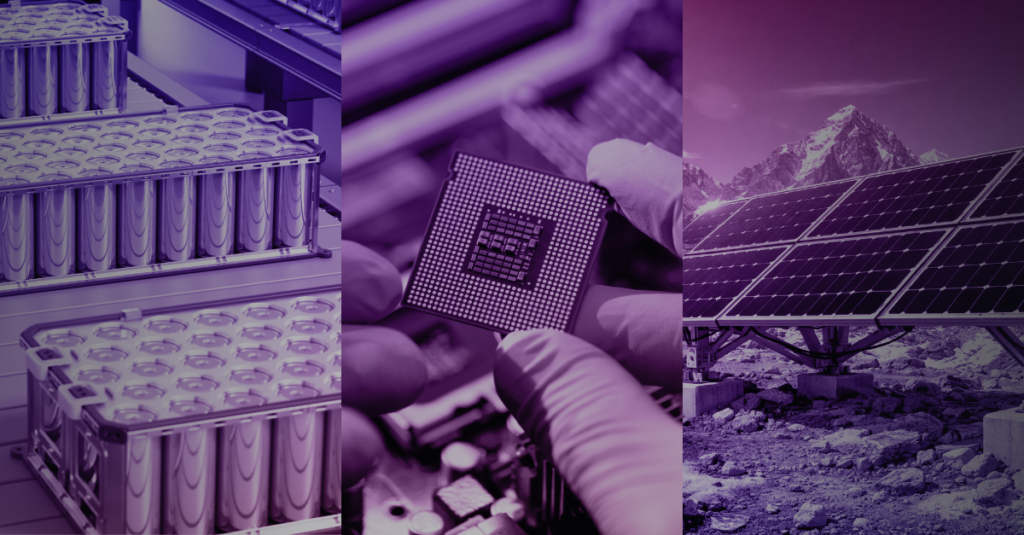
Or why it’s especially hard for an AI-first materials company
When we started Entalpic, the intuition felt almost too obvious to question: energy is a materials problem. Batteries come down to electrodes, electrolytes and interfaces. Solar to absorbers and passivation. Chemical production efficiency relies on catalysts and surface reactions. If AI could help us find better materials faster, surely the thing to do was point it straight at the biggest energy and climate problems and go.
So that’s what we did. For two years we worked through catalysis, electrochemistry, batteries, photovoltaics, industrial chemistry, talking to people in each one, mapping value chains, asking where better materials would move the needle most on emissions.
And we kept running into the same wall. It took us longer than we’d like to admit to understand why. But once we did, it changed about how we think building a company like this:
The scale that makes a technology matter for the climate is the very thing that makes it almost impossible to disrupt.
The trap, and why it catches us in particular
Here’s the tension, and it’s genuinely uncomfortable. The reason energy is such a compelling place to work is scale: a 1% improvement in something deployed across the entire planet has a massive environmental effect. But that same scale is a fortress.
When an industry runs at that volume, your new material isn’t fighting the incumbent material. It’s fighting an entire system built around it: optimized factories, qualified suppliers, decades of process know-how, customers who need a very good reason to change anything. At that scale, tiny gains in cost or yield compound across billions of units, and the incumbents are extremely good at defending that ground. That’s not a bug in these markets. It’s what maturity looks like.
There’s a sharper version of this we only reached recently. It’s not just that commodities have brutal economics, it’s that the materials used to produce them inherit the same constraints. Catalysts are the obvious case: a better catalyst sounds like a discovery problem, but its buyer is a commodity producer whose margins are set by the commodity price. And it’s not only cost. A catalysis plant running at scale won’t risk novelty, because trying something new might halt the line for a few days, and that downtime costs a fortune. The pressure of the commodity reaches one layer up, into exactly the materials we’d be tempted to work on.
Therefore, a better catalyst can have enormous climate value and still be a difficult business. A catalyst that saves 2% of the energy used in ammonia production sounds transformative at global scale. But to win adoption, it has to compete with a catalyst manufactured for decades, proven to survive years in a reactor, available in thousands of tonnes, and reliable enought to justify even a tiny probability of hutting down a billion dollar plant. Meanwhile the economic value captured by the catalyst supplier is only a small fraction of the climate value created.
Now, this would be a problem for anyone. But it’s a specific kind of trap for an AI-first materials company, because our entire edge is sophistication: better models, new chemistry, IP that didn’t exist before. That edge is worth the most early, when a material is novel and unproven, and worth the least in a mature, cost-driven market that pays for reliability and price, not for novelty. So we show up with the least mature version of the technology, into the market least willing to bet on immaturity, holding an advantage that the market doesn’t reward. A manufacturer scaling a known process doesn’t feel the trap the way we do. We felt it in every conversation, and we didn’t fully appreciate that going in.
We’re not giving up. We’re taking a different route
We want to be clear about what this is and isn’t. We haven’t lost interest in energy, and we’re not quietly walking away from the climate ambition. The destination is the same. What changed is the route, and honestly, the risk profile of the bet.
The instinct is to go straight at the biggest problem. But going straight in means proving industrial-scale economics before we’ve built the capabilities to deliver them, which is a fast way for a startup our size to run out of road. The opposite extreme, becoming a pure horizontal AI platform, dodges that but has its own failure mode: you stay a thin software layer and never build the real chemistry and manufacturing depth.
So we’re taking a third path: build deep materials and manufacturing capability in a market that can actually pay for sophisticated R&D today, and carry that capability toward energy as it matures.
For us, that first market increasingly became semiconductor materials and atomic scale manufacturing. Not because the chemistry is easier, quite the opposite, but because the economics are different. At advanced nodes, a material may represent a tiny fraction of the cost of a chip while determining whether an entire manufacturing step works. Purity, performance and process control can matter far more than cost per kilogram. That creates room for expensive computation, sophisticated chemistry and novel materials much earlier in their maturity curve.
But choosing that market does not make the challenge disappear. It changes the kind of risk we are taking. Instead of “can we survive a scale-driven market,” the risk becomes “can we genuinely transfer what we build.” We’d rather own that second risk with our eyes open.
You don’t always mature where you have the biggest impact
There’s real precedent for this. Early solar cells were far too expensive for rooftops, so they first found a home in space, where weight and reliability mattered more than cost. That demand kept the technology alive while it got cheaper, and decades later it became cheap enough for the terrestrial scale where its climate impact actually lives. Lithium-ion did the same: it started in camcorders and laptops, where energy density justified the price, long before it reached electric vehicles and grid storage.
The pattern isn’t a law. But it’s a reminder that a technology can grow up in one market and deliver its real impact in another.
And what carries across usually isn’t a finished product. It’s the capability underneath: the models, the data, the surface chemistry, the experimental methods, the manufacturing know-how. A first market can pay to build all of that. The energy application will still need new data, adaptation and scale-up, so the first market doesn’t do that work for us. It just makes us capable enough to eventually do it.
The question we keep asking ourselves
None of this is automatic, and this is the part that keeps us honest. A first market can also swallow a company: the customers and the data slowly pull you toward specialization until leaving isn’t really an option anymore. And scientific proximity is a trap of its own. Two industries can both be “about surfaces and coatings” while wanting to maximize different objectives, from purity, lifetime, geometry and cost.
So the question we come back to is: are we building a bridge to energy, or a comfortable place to stop?
Energy is still where we want to end up. We’re just no longer pretending the path to get there is a straight line, and being honest about it makes it feel more achievable.

